top of page
Real Numbers, Exponents, and Polynomials
Main topics
-
Classification of real numbers (rational / irrational / integer / whole / fractional)
-
Laws of exponents: product, quotient, power of a power, zero, and negative exponents
-
Rational (fractional) exponents ↔ radical form conversion
-
Simplifying algebraic expressions with exponents
-
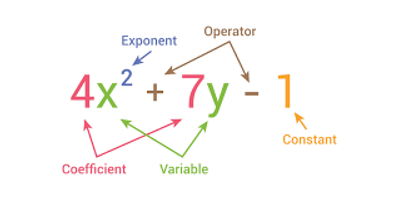
Introduction to polynomials: terms, degree, leading coefficient, standard form
-
Adding, subtracting, and multiplying polynomials
Key Skills
-
Apply exponent laws correctly
-
Simplify and evaluate expressions with rational exponents
-
Identify domain restrictions (no negative bases for even roots)
-
Combine and expand polynomials confidently
Summary
Students begin by revisiting powers and roots, learning how to simplify radical expressions, use exponent laws, and convert between radical and exponential forms. They explore rational and irrational numbers, focusing on how to simplify expressions containing square and cube roots. This unit helps students understand how radicals fit into algebraic structures and prepares them for later work in rational equations and logarithms. Accuracy with radicals and exponents is crucial because it forms the foundation for manipulating complex algebraic expressions.
Suggested Activities
-
Exponent-law practice worksheets
-
Conversion exercises (radical ↔ exponential)
-
Mini-quiz on polynomial structure and operations




bottom of page