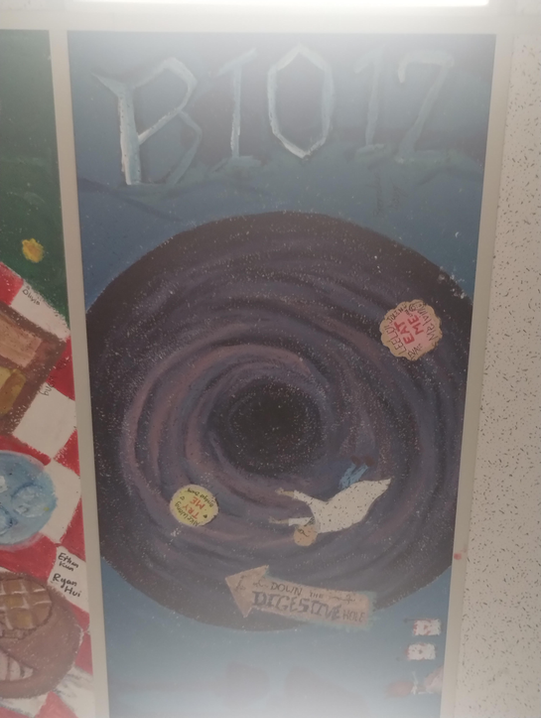
Biology
Raw Material

Incentive Biology Program
SC: ADVANCED PLACEMENT BIOLOGY 12
Prerequisite:
B or better in Life Sciences 11 or Life Sciences 11 Enriched, B or better in Anatomy & Physiology 12 or Anatomy & Physiology 12 Enriched OR taking Anatomy & Physiology 12 or Enriched concurrently.
Recommended: B or better in Chemistry 11
AP Biology 12 is designed to be the equivalent of first year university level biology and is therefore more challenging than Biology 12. The content of AP Biology can be successfully completed only if students have completed Life Science 11 and Anatomy & Physiology 12 previously, or if they are taking Anatomy & Physiology 12 concurrently with AP Biology 12. Life Science 11 Enriched and Anatomy & Physiology 12 Enriched are strongly recommended to build a better foundation for AP Biology 12. An important component of the AP Biology course is extended laboratory work. There are mandatory laboratory experiments that must be completed by all students, as these labs are examinable on the AP Biology exam. Success in the AP Exam also provides students with post-secondary credit for the equivalent courses. To qualify for first year university chemistry credit, students must obtain school credit and a minimum score of 4 (four) on the Advanced Placement College Board Biology Examination written in early May. All institutions may not give this credit though local universities such as UBC and SFU do.


Biology 8
In Grade 8, biology is taught as part of the general Science 8 course. Students begin with the basics of the cell theory, learning that all living things are made of cells and that cells are the smallest unit of life. They practice using microscopes and compare plant and animal cells, noting structures like the cell wall and chloroplasts that are unique to plants. They also study the difference between unicellular and multicellular organisms, and how cells divide to sustain life. In ecology, students are introduced to food chains, food webs, and energy pyramids, which show how energy moves from the sun to plants and then through different levels of consumers.
Biology9
In Grade 9, biology content in Science 9 focuses heavily on genetics and cell division. Students learn about the structure of DNA, the double helix, and how genes determine traits. They are introduced to Mendel’s laws of inheritance, exploring how dominant and recessive alleles are passed on to offspring. Typical classroom activities may include Punnett square exercises or extracting DNA from fruit. Students also learn the difference between mitosis and meiosis, understanding how organisms grow and reproduce. This stage helps them see the connection between genetics and real-life traits.
Biology 10
In Grade 10, biology is taught within Science 10, with an emphasis on ecology and human body systems. Ecology topics include the carbon and nitrogen cycles, showing how matter is recycled in nature, and how human activities like deforestation and burning fossil fuels affect ecosystems. Students also study biodiversity and invasive species, discussing why ecological balance is important. In human biology, they cover the basics of the digestive system, respiratory system, and circulatory system. Experiments might include enzyme activity labs or models that show how the lungs function. By the end of Grade 10, students are expected to connect biological concepts to global and environmental issues.

Teacher Interview questions
1. Can you describe what you teach in your biology class?
2. Can you describe the differences between Biology 11 and Biology 12?
3. Why do students take your biology class?
4. How does biology connect to future studies or careers students might pursue?
5. What do students like most about your biology class?
6. What dissections have your students done, and what others are they going to do?
7. How do you keep students engaged and motivated?
8. How do you assess student progress and learning?
9. What impact does your class have on everyday life?
10. What do students find difficult about your class?
Student Interview questions
-
What is your name?
-
Who is your teacher?
-
What are you learning right now?
-
Is this class difficult?
-
What is the most difficult thing about this class?
-
What is your average grade right now?
-
Do you enjoy this class?
-
Have you done any dissections yet?
-
What is your favourite lab so far?
-
Do you prefer group projects or individual projects?
Student interview 1 (Issac Gr 10)
-
What is your name? Isaac
-
Who is your teacher? Mr. Liang -
What are you learning right now? I am learning about DNA structures right now. -
Is this class difficult? The tests in this class are difficult, but I do well because I study. -
What is the most difficult thing about this class? The most difficult part of this class is the lab reports, since we have to put a lot of detail into them. -
What is your average grade right now? 85% -
Do you enjoy this class? Yes, I love learning about how our bodies work! -
Have you done any dissections yet? We have cut open a cow's eyeball so far. -
What is your favourite lab so far? My favourite lab so far was the cow eye dissection. -
Do you prefer group projects or individual projects? I prefer group projects because we all have our own individual strength, and together we can do better.

Student interview (Yuri
Gr 11)
1. What is your name? Yuri
2. Who is your teacher? Mr. Liang
3. What are you learning right now? We are currently learning about energy transformation in cells
4. Is this class difficult? If students study everyday, it is not too difficult at all!
5. What is the most difficult thing about this class? The most difficult thing about this class is the exams, because sometimes they are more advanced than the materials Mr. Liang gives us.
6. What is your average grade right now? 93%
7. Do you enjoy this class? I love doing the labs that Mr. Liang gives us.
8. Have you done any dissections yet? No, not yet.
9. What is your favourite lab so far? I have not done any labs yet.
10. Do you prefer group projects or individual projects? I prefer individual projects, since my groupmates sometimes are not the best.
What is biology?
Biology is the scientific study of life and living organisms. It is a broad natural science that encompasses a wide range of fields and unifying principles that explain the structure, function, growth, origin, evolution, and distribution of life. Central to biology are five fundamental themes: the cell as the basic unit of life, genes and heredity as the basis of inheritance, evolution as the driver of biological diversity, energy transformation for sustaining life processes, and the maintenance of internal stability (homeostasis).
Biology examines life across multiple levels of organization, from molecules and cells to organisms, populations, and ecosystems. Subdisciplines include molecular biology, physiology, ecology, evolutionary biology, developmental biology, and systematics, among others. Each of these fields applies a range of methods to investigate biological phenomena, including observation, experimentation, and mathematical modeling. Modern biology is grounded in the theory of evolution by natural selection, first articulated by Charles Darwin, and in the molecular understanding of genes encoded in DNA. The discovery of the structure of DNA and advances in molecular genetics have transformed many areas of biology, leading to applications in medicine, agriculture, biotechnology, and environmental science.
life sciences 11
Grade 11 offers the first dedicated Biology course, Biology 11, which goes much deeper into life sciences. A major focus is on the five biological kingdoms: bacteria, protists, fungi, plants, and animals. Students study their structures, life cycles, and ecological roles. They also learn about evolution and natural selection, including Darwin’s theory and evidence from fossils, anatomy, and molecular biology. Laboratory work is very important at this level; students may dissect worms or frogs to compare organ systems, and they may also conduct ecosystem field studies. The goal of Biology 11 is to give students a broad view of life’s diversity and how it has developed over time.

Anatomy and physiology 12
In Grade 12, students who continue with Biology 12 study advanced topics that resemble first-year university biology. The main focus is human anatomy and physiology, including detailed studies of the digestive, respiratory, circulatory, excretory, nervous, and endocrine systems. Students learn how these systems interact to maintain homeostasis. On the molecular side, they cover DNA replication, RNA transcription, translation, and protein synthesis, as well as enzyme function in metabolism. Labs may include modeling DNA replication or investigating reflexes in the nervous system. Biology 12 is particularly important for students preparing for post-secondary studies in medicine, nursing, or life sciences.

“R.C. Palmer AP Biology Requirements”
At R.C. Palmer Secondary School, the prerequisites and recommended academic standards for Advanced Placement (AP) Biology 12 are clearly outlined in the course guide. Students are required to have achieved at least a B grade in Life Sciences 11 or its enriched version, and similarly in Anatomy & Physiology 12 or its enriched version, or to be enrolled in AP Biology concurrently. (palmer.sd38.bc.ca) Additionally, the school recommends that students attain a B grade or higher in Chemistry 11 to ensure they have the necessary chemistry foundation for AP Biology. For standard Life Sciences 11 and Life Sciences 11 Enriched courses, the prerequisite is Science 10, with a recommended minimum of a B grade in Science 10 for students taking the enriched track. (palmer.sd38.bc.ca) According to the British Columbia provincial grading system followed by Palmer, a B grade corresponds to a percentage range of 73%–85%. (en.wikipedia.org) Therefore, while the school does not list a “biology cutoff score” per se, students typically need to achieve at least a B grade (approximately 73%) in prerequisite courses to qualify for enrollment in AP Biology 12.